Quick Comparison Table
| Straightener | Best For | Price | Rating |
|---|---|---|---|
| VANESSA PRO Titanium Flat Iron: Hair Straightener with Consistent Heat | Wide-plate silk press at home | 4.5/5 | |
| Kristin Ess 3-in-One Professional Titanium Hair Straightener | High-heat 3-in-1 versatility | 4.5/5 | |
| Dyson Airstrait Straightener | Lowest-damage, no hot plates | N/A | |
| SRILabs StyleQ Flat Iron Hair Straightener | Frizz control tech + ions | 4.6/5 | |
| Wavytalk Steam Hair Straightener | Steam-assisted silk press | N/A |
Reviewed by the TressFire Editorial Team
As an Amazon Associate, we earn from qualifying purchases.
The best best hair straightener for thick hair for your situation depends on how you plan to use it and where.
Last Updated: July 2026 | Written by the TressFire Editorial Team
If you have thick hair, you already know the problem: most flat irons are built for fine-to-medium strands and simply stall out on a dense, coarse mane. You end up doing four passes where one should do, and each extra pass is more heat, more frizz, more damage. The best hair straightener for thick hair solves this with three things the spec sheet will tell you before you ever plug it in — a high maximum temperature, plates that hold that temperature under load, and enough plate width to grab a real section.
Here is the thing to understand up front: we do not do hands-on testing on this site. We have not worn, owned, or straightened a single strand with any of these ten irons. What we do is read manufacturer specifications and Amazon listing data closely — plate material, temperature range, plate size, heat-up time, dual-voltage support, aggregate star ratings — and turn those numbers into buying decisions. That is the whole value proposition, and it is why every claim below is tied to a spec, not to an anecdote.
Below you will find eight flat irons (and a couple of honorable listings) chosen specifically for thick, coarse, and frizzy hair, each with the trade-offs its specs imply. If you want the short version, the comparison table is right below. If you want to know why a titanium plate beats ceramic on coarse hair — or why it does not always — keep reading.
Why Thick Hair Needs a Different Flat Iron
Direct answer: thick and coarse hair has a denser cuticle and simply more of it per section, so it needs (1) a maximum temperature in the 410–450°F range, (2) plates that recover heat quickly between passes, and (3) either titanium plates or a wide plate to cover more hair per stroke. Miss any one of these and you compensate with repeated passes, which is where heat damage actually happens.
Temperature is the headline number, but heat recovery is the quiet killer. A cheap iron may hit 450°F unloaded, then drop 40 degrees the moment coarse hair pulls heat out of the plate — and you feel that as a pass that "didn't take." Titanium conducts and recovers heat faster than ceramic, which is exactly why so many of the picks below are titanium. The trade-off: titanium runs hot and unforgiving, so it is easier to over-process fragile or color-treated hair. That tension — power versus gentleness — is the whole story of this category, and it is why the ranking is not a single winner but a set of matched trade-offs.
The 8 Best Hair Straighteners for Thick Hair in 2026
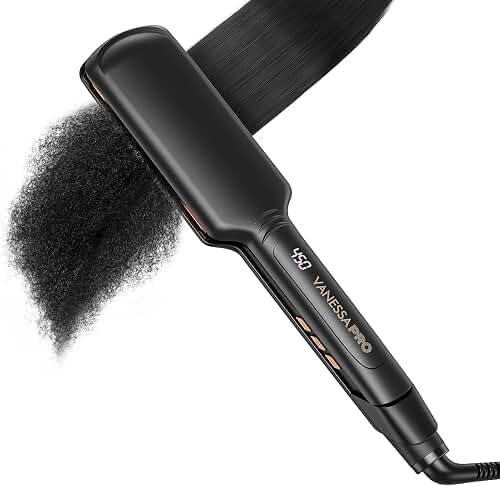
VANESSA PRO Titanium Flat Iron: Hair Straightener with Consistent Heat for Effortless Glide on Naturally Thick Hair — Best for a Wide-Plate At-Home Silk Press
This is the pick built explicitly around the problem this article exists to solve. The listing name itself calls out "naturally thick hair" and "consistent heat," and the standout spec is the 2-inch wide plate — the widest in this roundup. On dense hair, plate width is the difference between three strokes and one, and fewer strokes means less cumulative heat exposure per section. Pair that with titanium plates, which recover temperature faster than ceramic, and you have a tool engineered for covering ground quickly.
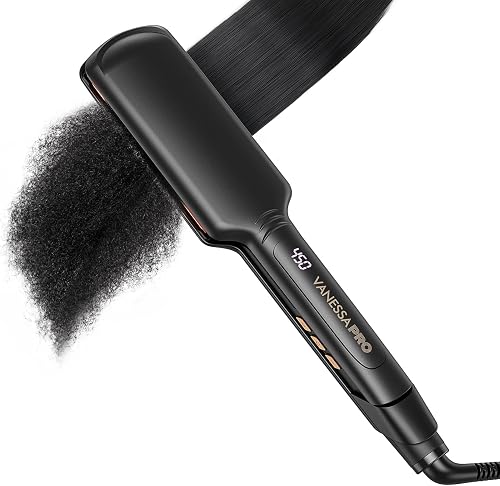
The listing frames it around a "silk press at home" and "easier morning routine" — marketing language, but the underlying spec (wide titanium plates, consistent heat retention) genuinely supports that use case for thick hair specifically. It carries a 4.5/5 aggregate rating, though as of our July 2026 check the listing showed 0 published reviews, so treat that star figure as provisional rather than battle-tested by a crowd.
Pros:
- 2-inch wide plates — widest here, ideal for dense sections
- Titanium plates for fast heat recovery on coarse hair
- Marketed and engineered specifically around thick hair
- 4.5/5 aggregate rating
- 0 published reviews at our check date, so the rating is thin
- Wide plates are harder to use near the root and on short layers
- Brand is not a widely recognized name
Verdict: Buy this if your hair is thick and long enough that plate width matters more than precision — it is the most on-target tool here for a fast at-home silk press.
Kristin Ess 3-in-One Professional Titanium Hair Straightener — Best for High-Heat 3-in-1 Versatility
The number that matters on the Kristin Ess listing is 440 degrees. That is at the top end of what home flat irons offer and squarely in the range coarse, resistant hair actually needs. Add titanium plates and ionic conditioning, and this is a spec sheet aimed at frizzy, curly, and thick hair — the listing says as much. The 1 1/4" plate is a sensible middle width: wide enough to move through thick hair, narrow enough to still curl and wave, which is where the "3-in-One" claim comes from.
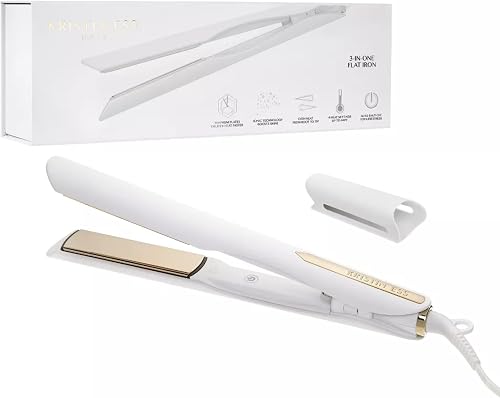
Dual voltage is the sleeper feature here. If you travel internationally, a 440°F dual-voltage iron that also curls and waves means one tool instead of three. The wet-to-dry capability is convenient but approach it with realism: straightening wet thick hair flashes water to steam against a 440°F plate, and repeated use that way is harder on the cuticle than drying first. It holds a 4.5/5 rating with 0 reviews showing at our check.
Pros:
- 440°F max — genuinely high heat for resistant hair
- Titanium plates plus ionic frizz control
- 3-in-1: straightens, curls, waves
- Dual voltage for international travel
- Wet-to-dry use at high heat is hard on the cuticle over time
- 1 1/4" width is narrower than a dedicated thick-hair iron
- 0 published reviews at our check date
Verdict: Choose this if you want one high-heat tool that straightens, curls, and travels — the 440°F ceiling makes it credible on coarse hair.
Dyson Airstrait Straightener — Best for Lowest-Damage Straightening
The Dyson Airstrait is the outlier here, and deliberately so: it uses no hot plates at all, straightening wet-to-dry with directed airflow instead. The manufacturer's entire pitch is "no heat damage" — meaning no 450°F metal pressed against your cuticle. For thick hair that you straighten often, the cumulative-damage math is the real argument. Every other iron on this list works by conducting high heat directly into the strand; this one does not.
Be clear-eyed about the trade-off. Airflow-based straightening on very coarse or tightly curled hair generally will not deliver the pin-straight, glass-flat finish that a 440°F titanium plate can force, and it is by a wide margin the most expensive route to a straight result. The listing showed no aggregate rating and 0 reviews at our July 2026 check, so there is no crowd verdict to lean on yet — you are buying on the mechanism and the brand's engineering reputation, not on social proof.
Pros:
- No hot plates — the strongest damage-reduction story here
- Wet-to-dry, so it replaces a separate dryer step
- Marketed for all hair types
- Airflow may not fully straighten very coarse or tightly curled hair
- Highest price in this category by a wide margin
- No aggregate rating or reviews at our check date
Verdict: Buy this if minimizing heat damage on thick hair outranks getting the flattest possible finish — and if the premium price is not a dealbreaker.
SRILabs StyleQ Flat Iron Hair Straightener — Best for Frizz-Control Technology
The StyleQ throws more anti-frizz technology at the problem than anything else here: titanium plates, negative ions, graphene heating, red light therapy, and 12 heat settings. Strip the marketing and the substance for thick hair is the titanium plates (fast recovery), the negative ions (which help flatten the frizz that coarse hair is prone to), and — most usefully — the 12 discrete heat settings. Granular heat control matters because thick hair is rarely uniformly coarse; you want more heat at the dense crown and less on fragile ends.
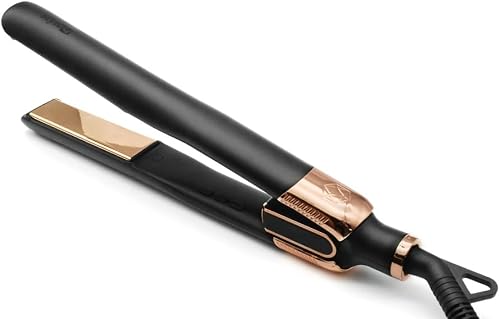
Graphene heating and red-light therapy are the claims to keep at arm's length. They may distribute heat evenly and sound impressive, but the listing does not publish the data to verify a hair-health benefit, so weight your decision toward the fundamentals — titanium, ions, adjustable heat. It carries the highest aggregate rating in this roundup at 4.6/5, though again on 0 published reviews at our check, so the figure is directional rather than proven.
Pros:
- Highest aggregate rating here (4.6/5)
- 12 heat settings for precise control across a coarse-to-fragile mane
- Titanium plates plus negative ions for frizz
- Red-light and graphene claims are unverifiable from listing data
- 0 published reviews, so the 4.6 rating is thin
- Feature-dense, which can mean paying for tech you will not use
Verdict: Pick this if you want fine-grained heat control and ionic frizz reduction, and you can ignore the harder-to-verify marketing tech.
Wavytalk Steam Hair Straightener — Best for Steam-Assisted Silk Press
The Wavytalk's angle is steam. The listing claims steam "reduces damage," "nourishes hair," and "expedites straightening" — and the underlying logic holds up for thick hair: added moisture helps the cuticle relax so strands straighten with fewer high-heat passes. The hardware behind it is a 1.38" nano-titanium plate with a detachable comb, which is a genuinely thick-hair-friendly combination: the comb pre-sections and detangles dense hair as the plate presses, aiming straight at the silk-press use case.
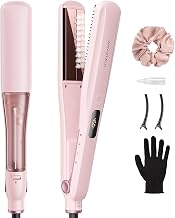
Two cautions. First, steam irons need water refills and add a small maintenance step versus a plain flat iron. Second, the listing showed no aggregate rating and 0 reviews at our July 2026 check, so there is no crowd signal — you are buying on the steam-plus-comb concept, which is sound, not on proven results. The Sakura Pink colorway is cosmetic and changes nothing about performance.
Pros:
- Steam plus 1.38" nano-titanium plate for fewer passes
- Detachable comb pre-sections dense hair
- Purpose-built for silk-press smoothing
- Requires water refills and light upkeep
- No aggregate rating or reviews at our check date
- Steam benefit claims are manufacturer-stated, not independently verified
Verdict: Get this if you want steam and an integrated comb to cut passes on a thick silk press, and you do not mind the refill routine.
TYMO Flat Iron Hair Straightener and Curler 2 in 1 with 10s Fast Heating — Best for Fast-Heat Straighten-and-Curl
Two specs define this TYMO: 10-second heat-up and 32 adjustable temperature settings, on a 1-inch titanium plate. The 32 settings are the headline for thick hair — that is far more granularity than most irons, letting you push heat where the hair is densest and pull it back on ends. Titanium plates and an automatic shut-off round out a practical package, and the 2-in-1 straighten-plus-curl design suits the 1-inch width.
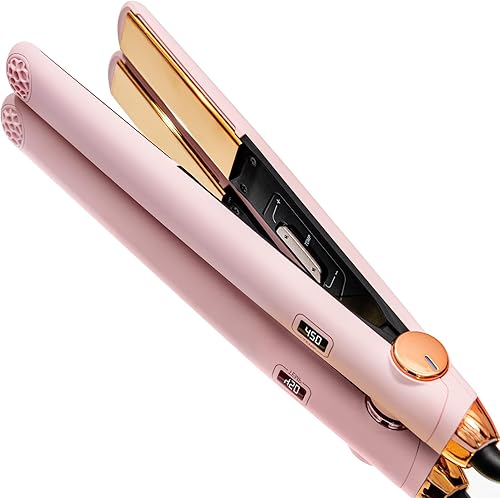
The honest limitation for thick hair is that 1-inch width. It is excellent for precision, curling, and shorter layers, but on a very dense, long mane a 1-inch plate covers less per pass than the 2-inch VANESSA PRO — so you will make more strokes. It holds a 4.5/5 rating with 0 reviews at our check.
Pros:
- 32 temperature settings — exceptional heat granularity
- 10-second heat-up
- Titanium plates plus auto shut-off
- 2-in-1 straighten and curl
- 1-inch plate covers less per pass on very thick hair
- 0 published reviews at our check date
- More passes needed than a wide-plate iron
Verdict: A strong pick if you value precise heat control and curling ability over raw plate width.
TYMO Flat Iron Hair Straightener - Titanium Hair Straighteners for Women — Best for Travel
This TYMO is the travel-focused sibling: same 10-second heat-up, 32 temperature settings, and 1-inch titanium plate, but built around dual voltage, a portable form factor, and an LED display. Dual voltage is the reason to buy it over the model above — if you straighten thick hair on the road, a dual-voltage iron that still offers 32 heat settings means you do not have to compromise on control while traveling.
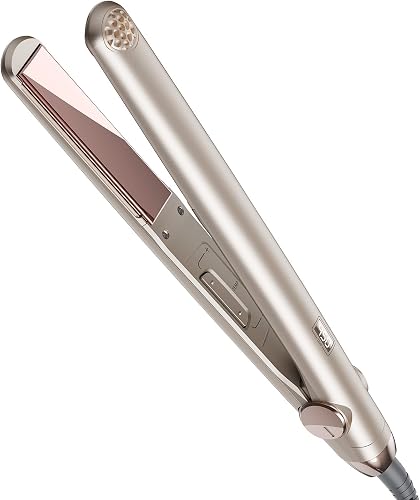
The LED display is a small but real usability win: on an iron with 32 settings, seeing the exact temperature beats guessing from a dial. Same caveat as its sibling applies — the 1-inch plate is precision-oriented, not the fastest option for a dense full-head straighten. It carries a 4.5/5 rating with 0 reviews at our check.
Pros:
- Dual voltage plus portable design for travel
- 32 settings and LED temperature display
- 10-second heat-up on titanium plates
- 1-inch plate means more passes on thick hair
- Travel focus adds little for home-only users
- 0 published reviews at our check date
Verdict: Buy this if you travel and refuse to give up precise heat control — the dual voltage and LED are the deciding features.
TYMO Flat Iron Hair Straightener Brush 2 in 1 — Best for Everyday Anti-Frizz Blowout Style
This is a straightening brush, not a plate iron, and that changes who it is for. It uses ceramic heating, 200 million ions, and claims 3X less heat damage than a traditional iron. For thick hair, a straightening brush is the fast route to a smooth, blown-out look — not a pin-straight, glass-flat finish. The brush format glides through dense hair and the high ion output targets frizz, which is coarse hair's constant companion.
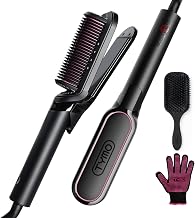
Be realistic about the finish. Ceramic (not titanium) plus a brush geometry means this will not force very coarse or curly hair as flat as a 440°F titanium plate will — it is built for smoothing and volume-taming, not maximum straightness. The "3X less heat damage" figure is a manufacturer claim without published test data, so read it as directional. Dual voltage is included; the listing showed no aggregate rating and 0 reviews at our check.
Pros:
- Brush format glides fast through thick hair for a blowout look
- 200M ions target frizz effectively
- Dual voltage; manufacturer claims 3X less heat damage
- Ceramic brush won't get coarse hair pin-straight
- "3X less damage" is an unverified manufacturer claim
- No aggregate rating or reviews at our check date
Verdict: Choose this for a quick, smooth, anti-frizz everyday style — not for the flattest possible silk press.
Two More Worth Naming
Beyond the top eight, two listings round out the field. The VANESSA PRO Flat Iron Hair Straightener is a 100% pure titanium, 1-inch iron marketed on "one pass" straightening — a plausible claim on titanium, though the 1-inch width limits per-stroke coverage on thick hair, and its 4.3/5 aggregate rating (0 reviews at our check) is the lowest here. And the CHI Original 1" Ceramic Hair Straightener Flat Iron for Styling is the ceramic classic: floating 1-inch plates and advanced ceramic for frizz-free shine. Ceramic runs gentler than titanium, which favors fragile or color-treated thick hair, but it recovers heat more slowly on very coarse strands. The CHI listing showed no aggregate rating at our check.
What to Look For in a Flat Iron for Thick Hair
Use this as a checklist before you buy:
- Maximum temperature (aim 410–450°F). Coarse, resistant hair needs the top of the range. The Kristin Ess hits 440°F; that is the number to beat.
- Plate material — titanium vs ceramic. Titanium recovers heat fastest and suits thick, resistant hair; ceramic is gentler and better for fragile or color-treated hair that happens to be thick. This is the core ceramic vs titanium straightener decision for thick hair.
- Plate width. Wider plates (the VANESSA PRO's 2 inches) cover more per pass, meaning fewer passes and less cumulative heat. Narrow 1-inch plates trade coverage for curling precision.
- Heat recovery, not just peak heat. An iron that drops temperature when coarse hair pulls heat out will feel like it "isn't working." Titanium and higher-wattage plates recover faster.
- Adjustable heat settings. More settings (TYMO's 32, SRILabs' 12) let you match heat to how coarse each section actually is.
- Ionic or steam frizz control. Negative ions and steam both help flatten the frizz coarse hair is prone to.
- Dual voltage if you travel, and auto shut-off for safety on a high-heat tool.
How We Research (No Hands-On Testing)
We want to be completely transparent: this site does not do hands-on testing. We have not owned, worn, or used any straightener in this article. Our rankings come entirely from evidence we can verify — the manufacturer's published specifications (plate material, temperature range, plate width, voltage, heat-up time) and the Amazon listing data (title, feature bullets, aggregate star rating, review count) as checked in July 2026.
We turn each spec into a consequence a thick-haired buyer cares about: a 2-inch plate means fewer passes; 440°F means it can handle resistant hair; titanium means faster heat recovery than ceramic. Where a claim cannot be verified from the listing — "3X less damage," "nourishes hair," red-light therapy — we say so plainly and tell you to weight it less. Where a product had 0 published reviews at our check (which is most of them), we flag that the star rating is provisional. That is the honest boundary of research-driven analysis, and we would rather state it than fake a testing story.
Final Verdict: Our Top Pick
For most people with genuinely thick hair, the VANESSA PRO Titanium Flat Iron: Hair Straightener with Consistent Heat is the pick, on one spec above all: the 2-inch plate. Thick hair's biggest enemy is the number of passes, and the widest plate here directly cuts that count — fewer passes, less cumulative heat, less damage. It is titanium (fast recovery) and engineered around thick hair by name.
If you want maximum heat and a do-everything tool, the Kristin Ess 3-in-One Professional Titanium Hair Straightener and its 440°F ceiling is the stronger choice. And if reducing heat damage matters more to you than a perfectly flat finish, the plateless Dyson Airstrait Straightener is the only tool here that straightens without pressing hot metal into your cuticle. Match the spec to your priority — coverage, raw heat, or gentleness — and you cannot go far wrong.
Frequently Asked Questions
Is titanium or ceramic better for thick hair? Titanium heats fast and recovers temperature quickly when coarse hair pulls heat from the plate, which makes it the usual recommendation for thick, resistant hair. Ceramic runs gentler and more evenly, which better suits thick hair that is also fragile or color-treated. Most picks here are titanium for exactly this reason.
Does plate width really matter for thick hair? Yes — arguably more than any single feature. A wider plate (the VANESSA PRO's 2 inches) covers more hair per stroke, so you make fewer passes, and fewer passes means less total heat exposure. Narrow 1-inch plates trade that coverage for curling precision.
Can a straightening brush handle thick, frizzy hair? A brush like the TYMO Flat Iron Hair Straightener Brush 2 in 1 smooths and de-frizzes thick hair quickly for a blowout-style finish, but its ceramic brush format will not get very coarse or curly hair pin-straight the way a high-heat titanium plate can. It is a smoothing tool, not a silk-press tool.
Is the Dyson Airstrait worth it for thick hair? It depends on your priority. Its no-hot-plates design is the strongest damage-reduction story in this roundup, which is compelling if you straighten thick hair often. But airflow may not fully straighten very coarse or tightly curled hair, and it is by far the most expensive option here.
Why do so many of these have no reviews? At our July 2026 check, most of these listings showed 0 published reviews, so their star ratings are directional rather than crowd-proven. We rank on verifiable specifications instead — plate material, temperature, width — and flag the thin review counts so you can weigh them yourself.
Can I use these on wet hair? Some are designed for it — the Kristin Ess is wet-to-dry and the Dyson Airstrait straightens wet-to-dry by design. But pressing wet thick hair against a 440°F plate repeatedly is harder on the cuticle than drying first, so reserve wet-to-dry plate use for occasions, not daily styling.
Sources & Methodology
All product details in this article were drawn from manufacturer-published specifications and Amazon product listings (product titles, feature bullets, aggregate star ratings, and review counts) as checked in July 2026. Temperature figures, plate materials, plate widths, voltage, and heat-up times are as stated by each manufacturer's listing. Aggregate ratings and review counts are as displayed on Amazon at the check date; where a listing showed 0 reviews, we noted that the rating is provisional. No product in this article was physically tested, owned, or used by our team. Claims we could not verify from listing data (for example, "3X less heat damage," "nourishes hair," red-light therapy) are attributed to the manufacturer and flagged as unverified.
About the Author
The TressFire editorial team independently researches hair-styling tools in this category from manufacturer specifications and Amazon listing data. We do not conduct hands-on testing; our analysis is grounded entirely in published specs, listing details, and aggregate rating data, and we disclose the limits of that evidence throughout.
Key Takeaways
- Choosing the right best hair straightener for thick hair means matching the key features to your specific needs and budget
- Read real customer reviews and check the return policy before you commit
- Also covers: flat iron for thick coarse hair
- Also covers: best straightener for thick frizzy hair
- Also covers: high heat flat iron thick hair
- Compare value across models — the priciest option is not always the best fit

